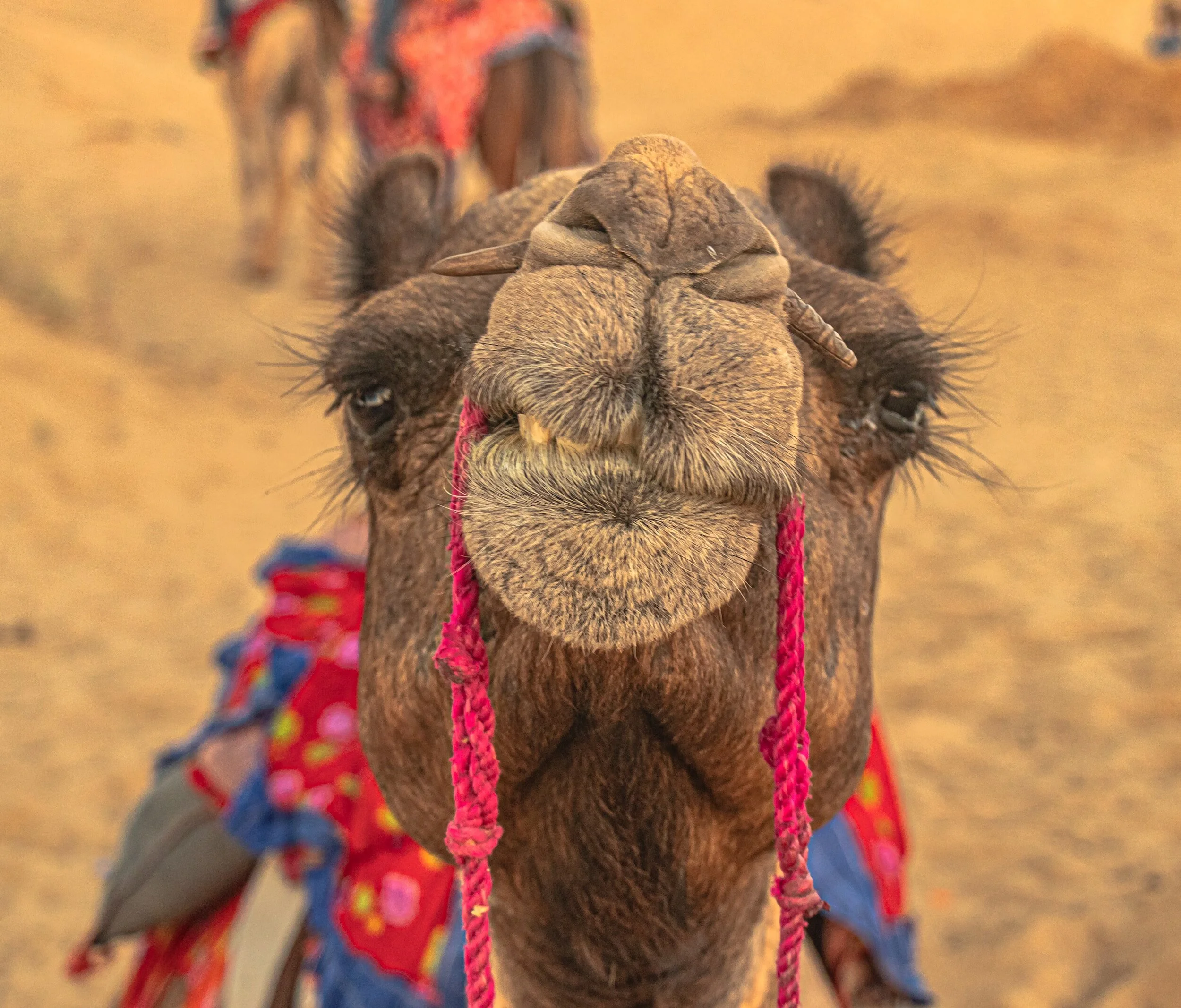
Dahabi the Camel or How The Camel Got Its Hump
All the animals were gathered at the marketplace under a huge, old date palm patiently waiting for their humans to return from trading and haggling with one another. It was hot, and they had waited for hours.
As you know, this is a bad combination, because when we are tired and hungry, the animals start getting restless and irritable. Their patience was wearing thin. Then they started picking on one another.
There was a young camel, called Dahabi (which means gold), standing near the market vegetable stall. Dahabi was a tourist camel. She took tourists for rides to see the pyramids in the desert. She had a camel saddle (called a howea in Arabic) on her hump. It was draped with brightly colored rugs and pillows in red, blue, yellow, and green. She also had little red, blue, green, and yellow pom-pom tassels on her bridle. The human who owned her had shaved beautiful patterns into her coarse golden coat, and she looked quite regal and resplendent.
A donkey, called Hagar, tethered to a nearby post, was losing her usual forbearance. The flies kept buzzing around her eyes, annoying her to no end. She twitched her ears impatiently, feeling weighted down and stuck in one place. She spied Dahabi, brayed sneeringly,
“Why are you looking down your nose at us with such a snooty look? You think you are so high and mighty in all your finery!”
Dahabi was startled by the sudden attack and said nothing.
“Yes,” bleated an old goat called Nazif, who had a sleek black and white coat and long beard.
“You never talk to us. You don’t have to think you are such a bigwig around here. Look how ugly you are with that scraggly, old coat you have. Your owner must shave patterns in your coat to try to make you look better.”
The animals were all listening. They were bored, tired, hot, and thirsty, and this mindless, mean attack on Dahabi gave them something to focus on and join in with. They didn’t really think about how they were ganging up on her or how it might feel to her.
“ Yes, you’re probably so hoity toity because you have all those fancy patterns cut into your bedraggled old coat,” agreed a squawking chicken as she scratched around in the dirt, picking up bits of fallen grain from the merchants’ bags.
Everyone started joining in, saying horrible, unkind things to Dahabi. She felt so humiliated. She didn’t feel highfalutin or proud; she felt ashamed and wanted to disappear.
A nearby sheep called Shahira stopped nibbling daintily at a bale of hay, looked up, and baaed, “And look at your feet! Great big, horny, old feet. I don’t know why you think you are so great.
Dahabi wanted to protest, “I don’t think I’m so great, I can’t help the way I look!” But she couldn’t find her words or dare speak to them.
“ And look at that hump,” growled an old Brahman bull called Bashir, “you look positively deformed.
A huge fat pigeon cooed softly and meanly, “You certainly have skinny legs and ugly knees.”
Dahabi felt beaten down and utterly dejected. She wanted to spit on the little pigeon and say, “Look who’s talking!” But she also didn’t want to be mean to someone, especially someone so much smaller than herself.
“ Not only that,” gobbled a turkey, “she has a funny long neck and thick ugly lips and the most hideous brown sticking out teeth I ever did see.” Deep inside the turkey was thinking, “At least I don’t have thick lips, a long tongue, and dirty teeth, because he did feel self-conscious about his long, scrawny, wrinkly red neck. But he didn’t even realize he was thinking that.
Dahabi, the little golden camel, was devastated. “Is that true? Do I really think I am better than them?” She asked herself. She had no idea that this was how others saw her. There was nowhere she could go, and she felt helpless and stuck. She felt so ashamed and ugly, and wanted to start crying. She tried to hide her head in shame, but it was so high up that she couldn’t put it anywhere. She felt mad inside but scared to say anything, so she just stood there while the other animals carried on ridiculing her and poking fun at her.
Now, a great big, black and white crow, called Malek (which means king), had been sitting nearby on the highest pole holding up the awning of the meat seller’s stall. He was watching for tasty morsels to fall to the ground, being as he is the bird that cleans up all the messes in the marketplace. He heard what was going on and started feeling very sad for the little camel, and very annoyed with the other animals, who were really saying whatever mean things they thought about themselves, to Dahabi.
Malek knew why the camel looked the way she did because he had heard the ancient stories of the desert from his father, who heard them from his father, who in turn heard them from his father, and so on, all the way back in time. Malek knew about the legends from the very, very long-ago days when the desert had been a jungle.
He cawed raucously and imperiously, and all the animals in the marketplace looked up and paid attention to him. They all knew they had to pay attention if the crow spoke because he was a messenger from the gods and the king of the birds, and he knew everything. No one dared to be rude to him.
“A long, long time ago, “ said Crow, “the whole of the Sahara Desert used to be a jungle. In those days, the camel had dainty little round feet to pick her way through the leaves under the big tree. She had a soft gold coat, big brown eyes, and a much shorter neck. Also, she did not have a hump. There was food everywhere, and she ate juicy fruits, sweet grass, and drank from all the clear, clean streams and pools hidden in the trees.
Then a terrible thing started to happen. People, who were not aware, and didn’t really think things through, and were greedy and selfish, came to the jungle and wanted to keep goats and sheep, chickens and donkeys, turkeys and oxen to work for them.” Now the animals were really listening to Malek!
“They started cutting down the trees and using the wood to make houses to live in and fires to cook their food. They cleared away the jungle so they could plant food they liked to eat and sell it at the market. Slowly, the jungle disappeared, and the hot sun baked the earth. The cool jungle streams dried up, and everything began dying. Eventually, even the people couldn’t live there anymore, and most moved away, except for some who lived in the few places left with water, called oases.
The humans made a big mistake. They got a lot from the jungle in the short term and used it all up because they were short-sighted.
They had no long-term vision or insight, and so they killed the whole jungle. All that was left were miles and miles of hot sand, being blown by the wind and burnt by the sun. Now there was nothing left for anyone, people, animals, or plants.
The midday sun beat down on the animals in the market as they listened to Malek the crow. They were all ears except for the chicken, who clucked disgustedly to herself about the humans and scratched distractedly in the dirt.
Malek continued, “Most of the other jungle animals died because they couldn’t survive, but the camel, being a very intelligent, resourceful, and enormously brave animal, learned to adapt to the changes that were happening around her. Her little feet began spreading out and getting bigger and bigger. She discovered that if they got bigger, they could stand on the shifting sand instead of sinking into it. In fact, her footpads seemed to float across the top of the sand, and she got to be called “the ship of the desert.”
The desert is a strange place. Because there are no trees for shade, it gets very hot during the day and very cold at night. The camel had to adapt to the hot and cold very quickly. She discovered that her thick, wide, spread-out feet covered with thick calluses could protect her from the icy cold sand at night and the stinging hot sand in the day.”
Shakira, the sheep who had made comments about Dahabi’s feet, started feeling rather sheepish and looked down, ashamed of herself for being so mean. She realized there was nothing wrong with Dahabi’s feet, but there was something wrong with her mean, superior comments. Suddenly, her dainty hooves didn’t seem to be so much better than Dahabi’s big feet.
“There was another problem in the desert,” said Malek the crow, looking at Nazif the goat, not unkindly, but pointedly,
“Because there were no sheltering trees left, the wind blew the sand into great dust storms. The sand stung right through the camel’s soft fur, and she cried with pain. But being an enormously intelligent and resourceful and brave animal, she discovered that if she grew some long scraggly, hard, coarse hair over her soft fur, it protected her from the sand blasts that would just about knock her over.”
Nazif, the goat, was feeling very uncomfortable. His judgmental comments and putdowns started making him feel bad. It was true, there was nothing wrong with Dahabi’s coat, but there certainly was something wrong with his arrogant attitude. He didn’t know Dahabi and hadn’t even understood how a camel got its rough coat. He also realized how vain he was about his own sleek coat – it was one of the things he thought made him special. As he thought about it, he realized that when he felt worthless, he would remind himself of his beautiful coat and feel better. So not only had he acted mean, but he was also, in fact, vain.
Malek the crow looked down sternly but gently at the animals. “Another thing,” he said, “is that the swirling sand and hot, hot air would get into the camel’s lungs and nostrils and burn her throat. She became so thirsty, and her throat burned raw from the sand and dryness and thirst. But again, being a very amazing, intelligent, resourceful, and brave animal, she learned that if she held her head just so, she could keep her eyes open to a slit and they would be protected from sand and wind by her very beautiful, long, black eyelashes. She learned to close her nostrils so the sand and hot air couldn’t get into her throat and lungs anymore. She also grew great tufts of hair out of her ears to catch the dust before it got into her ears. She is certainly not snooty; she knows how to keep sand out of her eyes and ears and nostrils.”
Crow paused.
Hagar, the donkey, bowed her head in shame. She had behaved in a most unseemly way for a donkey, which is usually a very humble animal that doesn’t judge others. Suddenly, she realized she was the one who had acted in a snooty way, not Dahabi. She felt particularly bad because the camel was young and had been taught to respect her elders, and so couldn’t defend herself or speak back to an older, crotchety donkey, who was truly acting like an ass. She thought some more and recognized a sneaking sense of jealousy that Dahabi got to carry tourists and was dressed in such finery, whilst she had to carry heavy baskets on either side of her back filled with papyrus reeds, grain, and vegetables. She also felt bad that she was the one who started all this and led the other animals astray.
The animals all stopped eating. They were all paying close attention to Malek the crow, who went on after a silence,
“All the trees that bore fruit and nuts, all the juicy, succulent plants and grasses died. All that was left were a few hardy trees called acacias that had big, sharp thorns. Oh, and very tough grass that managed to survive around the edges of small wells of water coming up from deep beneath the earth. The camel, being the most intelligent and resourceful of all the jungle animals, learned another trick. She found that when she found some grass, she would eat and eat and eat and learned to store the good fat from the food in a big hump on her back, so that when there was no food at all in the deep desert, she could use the stored fat in her body and survive.”
Now it was Bashir the bull’s turn to feel the shame of his nasty comments. He realized he was acting like a dumb ox in making mean statements, and he also realized there were times when he had wondered about the hump on his neck and felt scared that he was deformed in some way. A thought occurred to him, and relief washed over him,
“Is that why I have a hump on my neck, too?” he asked Malek.
“Yes,” cawed Malek, pleased with the question,
“Your body has also learned to store fat for days when there isn’t enough to eat.”
Malek paused, wondering if he should teach Bashir some more, and decided to add, “Seems like you were putting your judgment of yourself onto Dahabi. Now you can appreciate both your own ability as well as Dahabi’s.” Bashir didn’t know whether to feel good or bad about himself, but he certainly felt relieved.
Malek the Crow cawed on,
“ What I was going to say is that the thorny, old acacia tree was one of the few trees that could live in the desert, and it had tiny, green, juicy leaves high up and hidden in between big thorns. The camel’s neck grew longer and longer so that she could reach these high-up leaves. Her lips grew thick and hard so that the thorns would not prick her. Her teeth grew very big and strong so they could munch just about anything, even if it tasted hard and woody and unappetizing. She can chew up the long thorns of the acacia tree – now that takes some doing!” She grew a long, tough tongue that could wrap around the branches and strip away the green leaves.
The turkey felt a strange, new, tight feeling in his heart. He felt sad as he thought about all the hardships the camel had endured, and what that must have been like. The tightness began to melt into a warm feeling, and he felt like crying as he imagined the camels suffering and being brave. There was another feeling, too, of badness inside for having been such a turkey about saying spiteful things about Dahabi’s teeth and lips and neck.
Malek silently took note as Turkey changed its mind and felt a surge of joy. He continued with his story.
“Because camels were the only animals to be so intelligent, resourceful, and creative, people started using them to get across the desert. She was the only animal strong enough to survive the journey in the heat and the cold, the stinging sand and the unsheltered, vast, empty expanse of desert. Being a kind animal, she agreed to do this, but there was one thing she knew for sure. These people were not going to be mean to her, and when they were, she learned to do something else. She would grab them by their clothes with her big, strong teeth and would shake them around a bit. If they still didn’t learn to treat her with respect, she would spit at them in rage and anger. As a result, people, who can be very cruel and unkind and use animals without ever thinking about them, learned to treat her with respect and gratitude, and carved beautiful patterns in her golden coat. She decided to help people by kneeling so they could put heavy loads on her back, either side of her hump, which,”
said the crow, looking at the pigeon severely,
“is why she has big, calloused knees.”
Pigeon carried on pecking up grain on the floor. She didn’t even dare look up, thinking everyone was probably looking at her skinny legs and calloused knees now.
Chicken, too, realized she had been clucking on mindlessly, opening her beak before she thought. She shook her feathers in embarrassment
There was silence in the circle as everyone contemplated the most noble and courageous, the strongest and the most resourceful of all the animals in the desert.
Dahabi, the young camel, felt very uncomfortable being the center of attention. It was new for her to hear all these affirming things about herself. She smiled shyly and thanked Malek the crow for helping her see that there was nothing wrong with her at all. Dahabi silently vowed that the one thing she would never do to others was make fun of how they looked or how they coped with the hardships in their lives. Through Malek the crow, she could sense and feel their deep suffering, which was just the same as hers. She knew he was telling her that even deeper inside everyone lived their pure gold self, and that there was nothing wrong with them either. Malek had shown her that he knew they behaved badly only because they were tired and feeling helpless and ashamed of themselves, by being kind but firm with them, even though they had been mean. Only their pain made them do mean things, and they didn’t even know why they acted that way.
She felt a surge of inner power as she realized that she could speak up for herself. She did not feel so afraid of the other animals. They all felt bad inside about themselves, too. She would no longer be scared to demand the same respect from them that she did from humans. She made a silent, internal vow to speak up on her own behalf now that Malek the crow had shown her how to do so by speaking up for her in such a kind way to all the animals of the marketplace.
Just then, Abul-Hol (which means The Father of Terror), Dahabi’s human, came striding back to Dahabi. He looked irritable after a heavy morning of bartering in the market. He waved his hand at Malek the crow, “You noisy pestilence,” he shouted, “get out of here.” Just like the animals, he attacked others with what he thought about himself.
Malek gave a final caw of amusement and flew off in search of some more carrion to clean up.